The exhibition Vibrato will be presented in Trois-Rivières
Produced and put into circulation by the Joliette Museum of Art, the exhibition Vibrato curated by Marie-Hélène Foisy will be presented at the Raymond-Lasnier exhibition Center in Trois-Rivières from January 27 to March 25, 2018. The opening will take place on January 27th.
About:
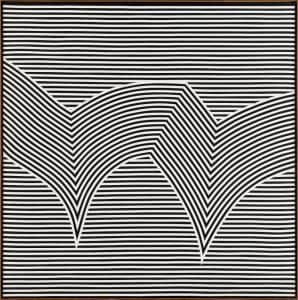
Marcel Barbeau, Manon à New York, acrylique sur toile, 1965. Collection du Musée d’art de Joliette. Don de Arthur Ruddy. Photo : Daniel Roussel © Succession Marcel Barbeau
Présentée à Trois-Rivières en janvier 2018, Vibrato
This exhibition, designed around Barbeau’s works in the collection of the Musée d’art de Joliette, is concentrated on the creative period from 1958 to 1967. It was at this time, following the dissolution of the Automatists, that his production was oriented toward a new search for movement in painting. No longer the result of spontaneous actions and gestures, his work gave rise to hallucinatory visions in which mystery – which had been so dear to the Automatists – asked only to be unveiled.
The Stockhausen revelations
“Intuition comes, according to my own experience, from a higher world. It is an influence from the cosmos, into our human mind.” Karlheinz Stockhausen, entrevue avec Lara Lee pourModulations, 1999
In 1958, when Marcel Barbeau was going through a period of deep soul-searching, a composer friend invited him to attend a lecture and concert by the German composer Karlheinz Stockhausen in Montréal. Stockhausen presented a number of new works, including excerpts from Gruppen. Barbeau had a revelation: the quality of this music, with its repetitive rhythms, vibratory effects, and electroacoustic sounds, struck his imagination. The importance of intuition and of “controlled randomness,” as well as the procedure of audio collage, which was central to the composer’s approach, fit with Barbeau’s artistic interests. When he returned to his studio, he created a series of felt-pen drawings directly inspired by the concert.
In these minimalist drawings, executed with great economy of gesture, red, black, and yellow lines clash, bounce off each other, or cross part of the surface and stop in a controlled randomness. Repetitive, straight, wavy, or vibrating, they sometimes create a rhythm and an oscillating movement that may suddenly vary in intensity. This production introduced a period of extremely intense and fertile exploration following which the artist created hundreds of drawings inspired by this concert. They marked an evolution in his artistic production: increasingly structured compositions and the presence of series of lines with diverging variations and structure were to characterize his optical works several years later. (Joliette Museum of Art)
Where:
Info:
Centre d’exposition Raymond-Lasnier
Joliette Museum of Art \ Musée d’art de Joliette